Prices as of Spring 2026. Prices are converted at 3 ILS to 1 USD — a convenient approximation, but the exchange rate fluctuates.
Our family moved from Boston to Jerusalem last year, and like many American immigrants, I arrived with twenty years of appliance knowledge that turned out to be mostly useless. Our kitchen in Brookline had a Frigidaire 30" double wall oven (FGET3065K). Here, that's not really a thing.
This isn't a definitive buying guide — I don't have a test kitchen, I didn't evaluate every model on the market, and I worked primarily with one store. What I have is a few months of research, some helpful conversations at Lior Electric in Talpiot, and the perspective of someone who had to learn the European appliance landscape from scratch.
What we chose: Two AEG ABU51229M ovens — one for meat, one for dairy — at ₪2,690 each (~$897). German-made, 71-liter capacity, Shabbat mode, steam cleaning. We didn't get pyrolytic (i.e. high-temperature) self-cleaning, and we're at peace with that.
Before We Get to 60cm: The American Oven Option
The first question I asked was whether I needed to buy Israeli appliances at all.
We learned from more seasoned locals that Bondy Export (40 Canal Street, NYC) has been selling 220-volt American appliances to expats and overseas diplomats since 1953. They sell GE and other familiar American brands pre-built for 220V, Israel's electrical standard.
For our kitchen, the relevant option was a GE 30" double wall oven. Bondy quoted two models:
| Model | Features | Price (USD) |
|---|---|---|
| JTD3000SNSS | Self-cleaning, no convection | $2,625 |
| JTD5000SVSS | Self-cleaning, convection in upper oven | $2,960 |
Both prices include delivery to a shipper in the NY/NJ area and installation plus one-year warranty from Keidar Sherutim, Bondy's Israeli service partner.
Getting the oven to Jerusalem added roughly another $2,100: receiving and export documentation ($250), shipping to Ashdod ($242), customs clearance ($165), port fees ($492), delivery to Jerusalem for normal access ($895), plus insurance ($75).
All-in, a double GE oven delivered to our Jerusalem apartment would run roughly $4,700–$5,100 — still quite competitive compared to buying two high-end German ovens here.
The appeal was obvious: a familiar double oven, excellent internal capacity (each cavity in a 30" double is larger than a single 60cm European oven), and no surprises in the kitchen.
One important caveat from Bondy: Israel runs on 50Hz current; the US is 60Hz. When running a self-cleaning cycle on these GE ovens here, the cycle shuts down prematurely during the cool-down phase and shows an error code. The fix is to reset the circuit breaker for a few minutes. It's not a disaster, but it's worth knowing going in.
Are any American appliances sold locally? Two friends told us about local appliance sellers with American ovens. One, Machsanei Givat Shaul, no longer imports American appliances; another offered a high-end 76cm Wolf double oven for ₪63,990 ($21,330). Not nearly in our price range.
Why we moved on: Our kitchen recess wouldn't fit a 30" oven without a renovation we weren't prepared to do. But if you're doing a full kitchen build-out with flexibility in your niche dimensions, the Bondy route is worth serious consideration.
The Israeli Standard: 60cm Built-In Ovens
Once we accepted that we were buying 60cm ovens, a few things needed relearning.
Capacity is measured in liters, not cubic feet. Most 60cm ovens are 71 liters — the standard across Bosch, Siemens, AEG, and Electrolux. Miele makes 76-liter models, as does Samsung. Whether that 5-liter difference justifies a significant premium is a judgment call; it didn't feel decisive to us. (For comparison, our 30” oven had a capacity of 4.2 cubic feet, or about 119 liters. 71 liters is about 60% of that.)
The brands our friends most recommend are German. German engineering has a strong reputation here for quality and longevity. But not everything marketed as a premium German brand is actually made in Germany, so it's worth looking up the model number and find its place of manufacture. Three friends bought Bertazzoni ranges from Italy — all noted their good looks and larger capacity (90cm, 142 liter); one friend complained of uneven heating within that capacity, though.
Understanding the Brands
Miele is a private, family-owned company with a single standard of quality (i.e. no lower-end sub-brands), all manufactured in Germany. Their ovens at Lior ranged from ₪7,990 to ₪11,990 (~$2,660–$4,000). Some buyers swear the longevity justifies the premium; I don't have personal data on this.
Bosch and Siemens are the same company (BSH Hausgeräte GmbH). Many of their ovens are made in Germany, but not all — the more affordable Bosch models in our research were made in Poland; the more affordable Siemens models were made in Spain. Upper-tier German-made models started around ₪6,000 (~$2,000). Worth confirming the spec sheet before assuming. (Bosch’s Israel website does make it relatively clear which products are made in Germany, which in the EU, and which elsewhere.)
AEG and Electrolux are both brands of the Swedish Electrolux Group. Some of their ovens are made in Germany; some are not. The German-made AEG models at Lior in Spring 2026 ranged from ₪2,990 to ₪3,890 (~$997–$1,300).
Two Decisions That Influenced Everything Else
For our kitchen, two questions ended up driving the rest of the decision: self-cleaning and Shabbat mode. There was real tension between them — though if Shabbat mode isn't a factor for you, the decision simplifies considerably.
Self-Cleaning (Pyrolytic)
In Israel, the term for electric self-cleaning is pyrolytic (פירוליטי). The oven heats to approximately 500°C (930°F), incinerating food residue and leaving only ash to wipe away.
Some people advise against relying on it heavily. Yale Appliance, a Boston-area retailer whose blog I've found reliable, puts it plainly: “Never self-clean your oven before a holiday or cooking event. Self-cleaning is a 900-degree heat cycle that can cause problems in older ranges.” My own experience with Frigidaire ovens in the US — semi-annual pyrolytic cleaning over many years — was fine. My mother uses the shorter self-cleaning cycle several times a year without issue. Your mileage may vary.
The deciding opinion: my wife doesn't like the smell. We opted out.
Shabbat Mode: Calibrate Your Expectations
If you moved here from a US kitchen with a fully-featured Star-K–certified Shabbat mode — timed bake on Shabbat, temperature adjustment on Yom Tov — you need to adjust expectations before you start shopping.
Israeli Shabbat modes are substantially more limited. In the models I encountered, the Shabbat function converts the oven into a warming device: it disables the thermostat and interior lights completely, and maintains a constant temperature of 65–90°C (149–194°F) by cycling the heating element on a fixed timer. Opening and closing the door doesn't affect it. You cannot bake with it. You cannot adjust temperature on Yom Tov.
In practical terms, it functions more like a warming drawer than a Shabbat-mode oven in the American sense.
One useful thing I found by reading product manuals: the Bosch HBG7741B1, a German-made pyrolytic oven (₪5,988, ~$2,000), doesn't have a dedicated Shabbat mode, but it does have instructions that sound suspiciously like one:
You can use your appliance to keep meals warm for up to 24 hours without changing the behaviour of the appliance. Use the time functions and change the basic settings.
See section “8.8 Keeping warm over an extended period” in the HBG7741 user manual:
Given how much Yom Tov cooking we did in the diaspora, adjusting to these limitations might be a real shift. But there’s so many fewer Yom Tov days here, and the holiday take-out options are considerable. Ultimately, since it's essentially a warming function, we decided it wasn't our primary criterion — if we don’t love it, we’re fine relying on a plata.
The Tension: Getting Both
When I asked Oded Gordon at Lior Electric's Talpiot branch whether there was a 60cm oven offering both pyrolytic cleaning and a Shabbat mode, he said there was only one: the Teka HLB 8200P SHABAT (₪3,990, ~$1,330), made in Spain.
What I Found at Lior: The Contenders
I visited the Talpiot branch of Lior Electric and focused on German-made, 60cm models.
German-Made, 60cm, with Shabbat Mode
These use steam-based or hand cleaning rather than pyrolytic.
| Brand | Model | Cleaning | Price (ILS) | Price (USD) |
|---|---|---|---|---|
| Electrolux | EOH74279X | Steam | ₪2,790 | $930 |
| AEG | ABU51229M | Steam | ₪2,990 | $997 |
German-Made, 60cm, Pyrolytic — No Dedicated Shabbat Mode
| Brand | Model | Cleaning | Price (ILS) | Price (USD) | Notes |
|---|---|---|---|---|---|
| Bosch | HBG7741B1 | Pyrolytic | ₪5,988 | $2,000 | See timer notes above |
| Miele | H2861 | Pyrolytic | ₪7,990 | $2,660 | 76L capacity |
Our Choice: AEG ABU51229M
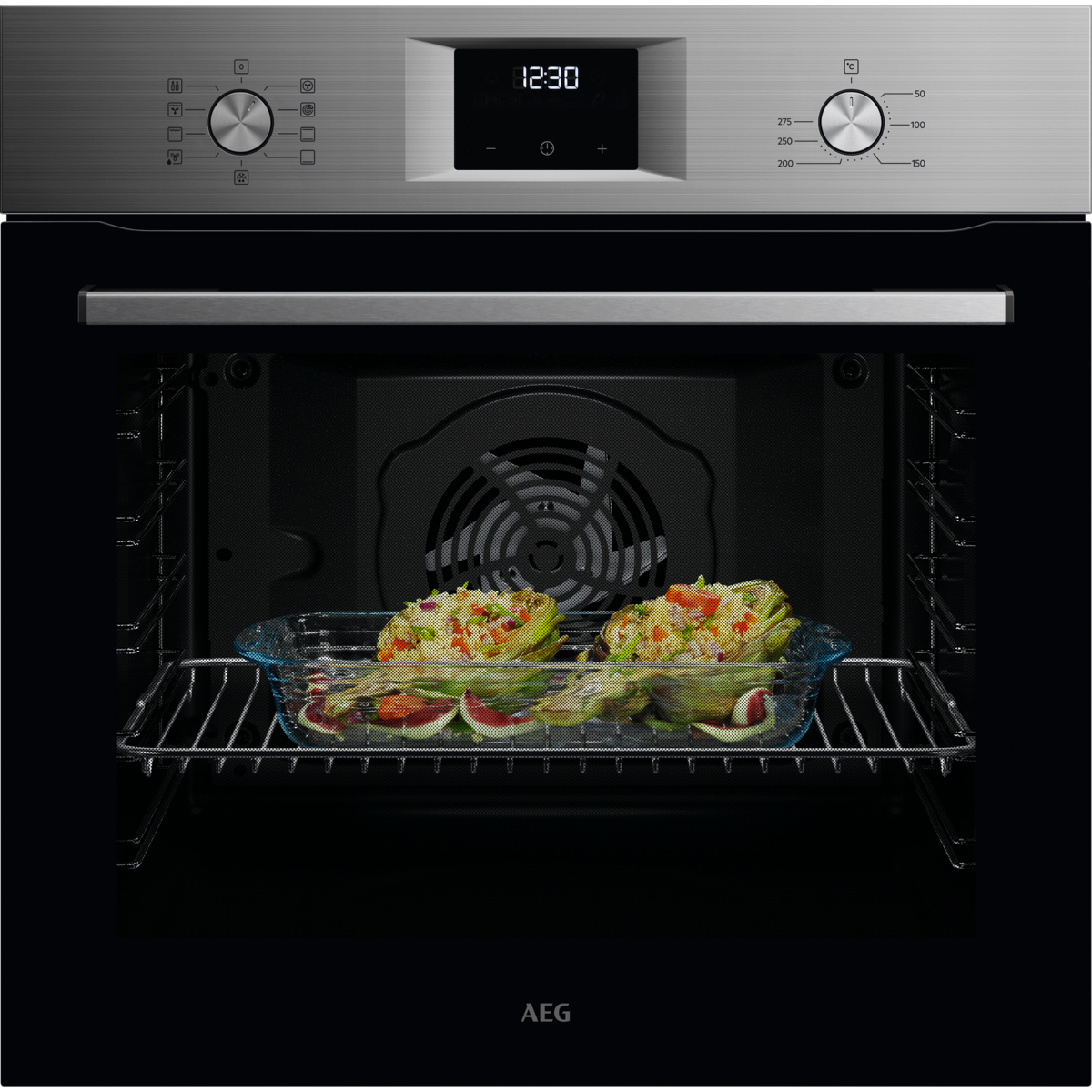
We bought two — one meat, one dairy — at ₪2,690 each (~$897) in Spring 2026 at Lior Electric (the list price was ₪2,990; we bought during a Shavuot sale).
What it has:
- Made in Germany
- 71-liter capacity
- Shabbat Mehadrin certification — thermostat and lighting are completely neutralized; temperature holds at 65–90°C (149–194°F) regardless of whether you open the door
- Aqua cleaning: a steam cycle at 90°C (194°F) for 30 minutes, in place of pyrolytic
- Easy-Clean enamel interior coating
- 9 cooking modes: turbo/convection (AirHot), grill, pizza, defrost, Shabbat, and others
- Two sets of telescopic rails
- Full-width baking pans that span the entire interior width, rather than a narrower pan on a wire rack
- Removable door for easier cleaning
- 3-layer glass door; the exterior stays cool to the touch
- Temperature range: 50–275°C (122–527°F)
- Fingerprint-free stainless steel
- Energy rating: A+
What it doesn't have: Pyrolytic self-cleaning; convection in every mode (the AirHot/turbo setting is the fan-assisted option).
We’ve had good luck with Electrolux appliances in the US, and we’re hoping their German-made AEG ovens will hold up similarly. If not, the considerable savings against a Bosch or Miele model will soften the blow.
One practical note on capacity: the oven's upper temperature is 275°C (527°F). Most roasting and baking stays well below that ceiling, but I used to bake pizza at home at 550°F — not fully achievable here.
What I Wish I'd Known
The Shabbat mode here is really just a warming function. Once I recalibrated that expectation, the decision simplified. If all it does is keep food warm, a plata does the same thing — so I stopped treating Shabbat mode as a must-have and started treating it as a nice-to-have.
The country-of-manufacture question may matter more than I expected. The same brand can have models made in Germany and others made in Poland or Spain. The spec sheet should list the origin; check it. It's not obvious from the product name or the store listing.
Read the product manual before you buy. Store listings and spec sheets often don't capture how the oven actually works day to day — which modes do what, what the Shabbat cycle actually does, how long the cleaning cycle takes. Both Electrolux and BSH post full manuals online. That's where I found the Bosch timer information; I wouldn't have known to look without digging.
Having an English-speaking salesperson who can explain local context makes a difference. The Israeli appliance market has its own logic. Oded Gordon at Lior gave me genuinely useful perspective on which features Israelis actually use — not just what the product can do.
The Miele warming drawer is wonderful and expensive. We have one in the apartment we're renting now, and it's excellent for Friday nights — roasted chicken and side dishes held perfectly through the meal. At ₪11,000 (~$3,670) at Lior, it felt like too much for our budget. But if I were designing a kitchen without constraints, I'd include it (and pair it with a fancy Miele oven).
Comments